
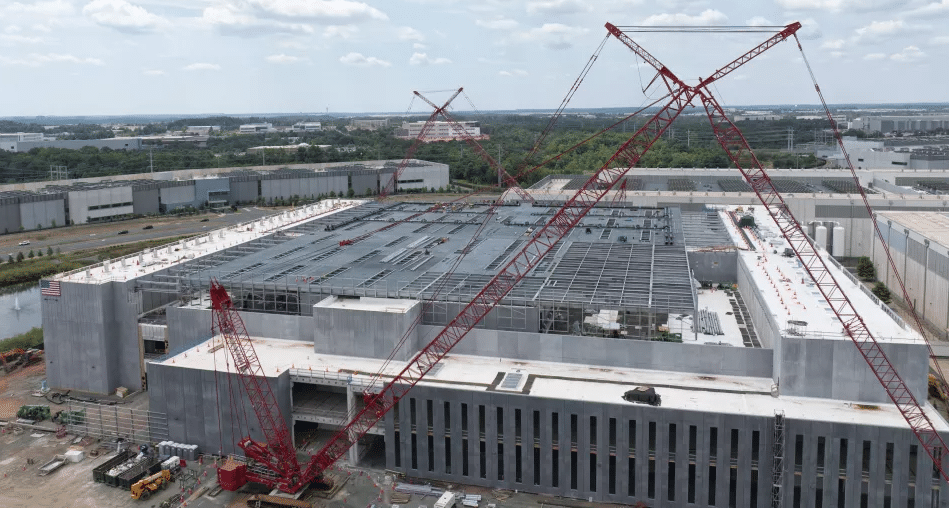
On a $4 billion data center construction program, a one-percentage-point WIP error in reported completion can shift recognized revenue and the corresponding WIP position by $40 million. At that scale, a seemingly small variance can affect reported margin, overbilling or underbilling, working-capital decisions, and the financial information provided to lenders and surety partners.
Accurate reporting depends on current cost estimates, complete commitment data, properly reflected change orders, and consistent rollups across every phase and entity. When any one of those inputs falls behind, the resulting variance can distort the portfolio-level financial picture that executives rely on—well before the underlying issue surfaces during the monthly close. The $40 million represents a reporting effect, not necessarily a cost overrun or a realized loss.
Data Center Construction Contracts have Outgrown Old WIP Processes
Data center programs magnify ordinary WIP errors because small percentage variances are often applied to very large contract values, complex scopes, and multi-entity reporting structures. Data center construction has grown faster than many contractors’ reporting processes. Newmark’s 2025 U.S. Data Center Market Outlook describes campuses ranging from 400 to 900 MW, with some planned programs exceeding 1 GW. MSI/MOCA’s Sizing the Surge 2025 report describes the scale of these programs, while iRecruit reports that the average cost per megawatt (MW) has jumped to $11.3 million globally. At that level, project budgets are measured in billions instead of millions.
Microsoft announced a $3.3 billion Wisconsin data center investment, while Meta’s Louisiana project was initially announced as a $10 billion AI-optimized data center. Projects of this size can include several buildings and phases, dense MEP scope, multiple legal entities, overlapping schedules, and frequent changes to the cost-to-complete estimate. Accounting and finance must reconcile the same WIP position at the project, phase, legal-entity, joint-venture, and portfolio levels. A difference that appears manageable within one project can become material when the entire program is consolidated. A WIP process designed for a $30 million or $50 million job may carry a relatively small percentage variance into a much larger program, where the dollar exposure is far greater.
How a One-percentage-point WIP Error Moves Through Reporting
Under ASC 606, many construction contracts recognize revenue over time. A cost-to-cost method commonly measures progress by comparing costs incurred with the latest estimate of total cost. That estimate drives percent complete, earned revenue, gross profit, and overbilling or underbilling balances. Consider a simplified $4 billion contract. If the correct percentage of completion is 40% but the WIP schedule reports 41%, that one-percentage-point difference overstates earned revenue by $40 million and can distort the reported WIP position on a comparable scale. The effect can flow through:
- Revenue recognized for the period.
- Projected gross profit and profit fade.
- Overbilling and underbilling balances.
- Cash, credit-line, and covenant decisions.
- Backlog quality and reported bonding capacity.
WIP errors can result from an outdated estimate at completion, an open commitment missing from that estimate, an unprocessed change order, incorrect data mapping, or spreadsheet formula errors. In each case, construction WIP reporting no longer reflects current costs and commitments.
A Three-week Close Leaves Executives with Stale Data
A three-week close may have been workable on a $50 million project, but by the time your executives receive the WIP position, they may already be making working-capital and credit decisions based on data that is no longer current. On a $2 billion program, exposure related to labor, equipment, subcontracts, and change orders can move by millions of dollars every day.
Turner & Townsend’s 2025 data center construction cost index reports that costs increased 9% year over year in 2024, with MEP systems among the main cost drivers. Applying a 9% increase to a $2 billion cost base equals $180 million. This is a scale illustration, not a forecast for every program; it demonstrates the volume of cost change that finance may need to reconcile against the original project budget during execution.
In a manual WIP process, finance exports job-cost data, collects revised estimates, updates spreadsheets, reconciles entities, checks formulas, and posts adjustments. By the time the rollup is finished, another change may already have occurred, leaving the completed report out of step with current project conditions.
Executives Need Portfolio Margin Before Month-end
A contractor may be running several campuses, phases, or joint ventures at once. If each entity maintains its own report and finance consolidates the portfolio in Excel, the CEO sees margin exposure only after the rollup is complete. That delay leaves leadership without timely answers to critical questions:
- Which programs lost margin this week?
- Which estimate-at-completion changes are still awaiting approval?
- Which pending change orders are included in contract value before approval?
- Which entities or phases are consuming working capital?
- How does the current portfolio affect the company’s ability to bond the next award?
These questions should not require a new spreadsheet rollup. If the answers arrive only after the monthly close, management loses critical time to address the cost or contract issue behind the variance.
WIP Quality can Affect Surety Capacity
Sureties also review WIP. The National Association of Surety Bond Producers notes that financial statements, WIP schedules, and bid projections help sureties evaluate a contractor’s capacity. Inconsistent or difficult-to-reconcile WIP can create questions when the contractor seeks to expand its overall bonding line or secure higher single-project and aggregate limits. At this scale, reporting quality can become a practical growth constraint. A contractor may need an increased single-job limit for the next phase while underwriters are evaluating whether the current WIP position can be reconciled consistently. A repeatable close does not guarantee a larger bond program, and software does not replace underwriting judgment. A consistent WIP process can, however, help finance provide reliable figures for contract value, earned revenue, cost to complete, backlog, and margin movement.
Automated WIP Shortens the Reporting Cycle
These demands create a common reporting requirement: finance needs a current, traceable WIP position across the portfolio. Sage Intacct Construction’s automated WIP functionality creates monthly WIP statements, records WIP data in the ERP system, and can automatically generate overbilling and underbilling general-ledger transactions. Sage Intacct revenue recognition supports automated, ASC 606-compliant recognition workflows, while project accounting can calculate and post revenue based on percentage of completion. Together, these capabilities connect the WIP calculation, its audit trail, and the portfolio view:
- Current job costs and estimates feed the WIP calculation.
- Historical WIP positions remain available for review instead of being overwritten in a workbook.
- Overbilling and underbilling entries are tied to the underlying schedule.
- Multi-entity consolidation reduces separate exports and manual elimination work.
- Dimensions show margin by entity, campus, project, phase, customer, or project manager without expanding the chart of accounts.
Finance can review margin when an estimate changes instead of waiting several weeks for the monthly rollup. Earlier notice gives project and finance leaders more time to review the estimate, resolve an unprocessed change, or address a cost overrun. The following customer results illustrate the multi-entity consolidation and faster project reporting capabilities behind this approach.
Orion Companies expanded to more than 13 divisions and entities and replaced a 10-day reconciliation process for 40 bank accounts with real-time daily reconciliation. The result demonstrates how multi-entity capabilities can give leadership a more current view of cash across a group.
GeoTechnologies saved about 15 hours per month on project reporting, replaced repeated Excel work with dimensional reporting, improved the quality and timeliness of its financial reporting, and gained real-time visibility into project and client profitability. These results illustrate faster project reporting and cleaner delivery of financial data for insurance underwriting. The firm recovered its Sage Intacct investment in less than five months.
At $4 billion, WIP Accuracy is an Executive Issue
No forecast will be perfect. Finance still needs WIP that updates when project costs and estimates change, preserves supporting history, and shows the effect across the portfolio before month-end. At $30 million, a one-percentage-point WIP error may be contained within a project review. At $4 billion, that one-percentage-point variance can misstate the reported WIP position by $40 million.
SWK Technologies helps construction firms evaluate and implement Sage Intacct Construction for automated WIP, ASC 606-aligned revenue recognition, multi-entity consolidation, and dimensional reporting. Talk to SWK Technologies about reporting requirements for large data center construction programs.