

Midmarket commercial bakery and food process manufacturers set standard costs on a quarterly cycle, so most bakery ERP software was configured on the assumption that a quarter is fast enough. That assumption held for years, although ingredient markets have long since stopped moving at anything like that pace.
A commercial bakery running $50 million in revenue could spend roughly $15 million a year on flour, oils, sugar, dairy, and packaging. Flowers Foods, one of the largest US packaged bakery producers, reported materials, supplies, labor, and other production costs at 51% of net sales for fiscal 2025, and ingredients and packaging sit inside that figure alongside labor.
Here is a quick breakdown on the math:
- Annual revenue: $50 million
- Ingredient and packaging spend, at 30% of revenue: $15 million
- Average gap between standard and actual across the basket: 10%
- Annual exposure: $1.5 million
A 30% ingredient and packaging share sits well below 51% and the 10% gap is modest next to flour, where farm-level wheat moved 14.7% in a single month.
Controllers see the gap every time a variance report lands three weeks after the batches ran, the product shipped, and the price was agreed with a grocery customer. Meanwhile, for CFOs it surfaces later as margin that never appears in the forecast.
Nothing here is broken, and no one made a mistake. Still, the gap accumulates between the day a standard is set and the day anyone reconciles against it.
Standard Costs Break in a Volatile Quarter
The costing cycle didn’t change, but the market underneath it did. That’s why understanding how far inputs can move inside a single quarter is where costing modernization starts.
How Fast Do Commodity Inputs Move?
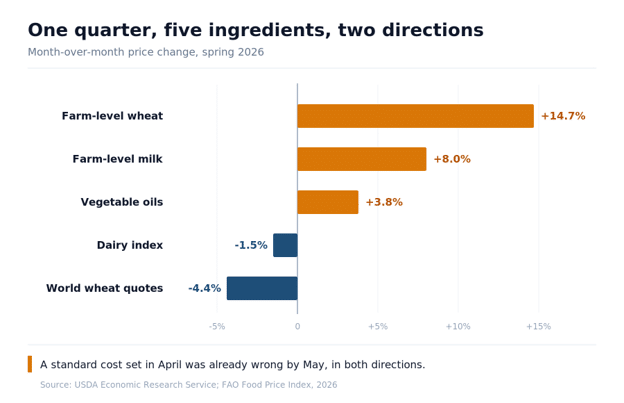
Far enough inside one quarter to invalidate the standard you set at the start of it. Between April 2026 and May 2026, US farm-level wheat prices rose 14.7%, leaving them 31.2% above the prior year. Farm-level milk climbed 8.0% in the same month, its fourth consecutive increase. Over the same spring, world wheat export quotations fell 4.4%, and the FAO dairy index slipped 1.5%.
Wheat showing up in both columns is not a data error. US farm-gate prices and world export quotations answer to different pressures, which is much of what makes forward buying hard. A bakery sourcing domestic flour and one sourcing imported oils were reading two different markets that quarter.
So the inputs on a single formula moved in both directions inside three months, one of them by double digits. A standard set in April was already wrong by May. The errors partly canceled, while the blended number still looked reasonable, resulting in the harder version of the problem.
USDA economists forecast farm-level wheat up 21.1% for 2026, with a prediction interval running from 6.1 to 39.8%. Analysts with full market visibility cannot narrow that below a 34-point band. Set against it, a quarterly standard is a single number carried to two decimal places.
Why Food Manufacturers Feel It Before Consumers Do
Producer price indexes are also more volatile than consumer indexes, so the prices a manufacturer pays swing harder than the prices its customers see. The American Bakers Association notes that even small increases in input costs carry through to the finished product.
Trade policy reaches the same cost lines, because bakeries source ingredients, packaging, and equipment across borders. ABA president and CEO Eric Dell told Snack Food & Wholesale Bakery that shifting trade frameworks have “made predictability more challenging, which directly impacts cost structures and operational planning,” adding that the industry has answered with real-time economic data.
Commercial Baking reported from ABA’s 2026 convention that former US trade representative Katherine Tai told bakers tariffs are here to stay, so none of this looks like a passing spike. When a market stops being predictable, forecasting harder doesn’t help as much as measuring faster, which is one reason food manufacturers keep moving toward connected plant data.
Why the Standard Cost Cycle Runs Quarterly
So why not update standards more often? Changing a standard revalues on-hand inventory, restates work in process, and produces a revaluation entry someone has to explain.
Multiply that across a few thousand SKUs and the roll becomes a project rather than a task, so it gets batched into the quarter with everything else. Few companies choose that cadence deliberately, but legacy bakery management software created the trends that made it the cheapest option.
Forward buying complicates it further because a bakery that locks flour purchases for two quarters carries a purchased cost that may sit well away from the spot price. When the standard tracks neither the hedge nor the market, variance reporting measures against a benchmark that matches neither, and a buyer who bought well can still show an unfavorable number.
Where Standard Cost Drift Hides in a Bakery
The drift arrives in three forms, and they behave differently:
- Purchase price variance is the gap between what you paid and what the standard assumed.
- Usage or yield variance opens when the line consumes more than the formula calls for.
- Mix or substitution variance appears when what went into the batch is not what the recipe specified.
As each has a different owner and a different fix, a single blended variance line tells a controller very little. Plus, most food industry ERP software reports the total while leaving the breakdown to a spreadsheet.
Yield hides the first share. A formula says 1,000 pounds of flour yields 1,180 pounds of dough. The line produced 1,150, and the difference is moisture, scrap, line loss, and rework. On one batch that is a rounding error, but across four thousand batches a quarter, it becomes a number a CFO wants in week two rather than week thirteen.
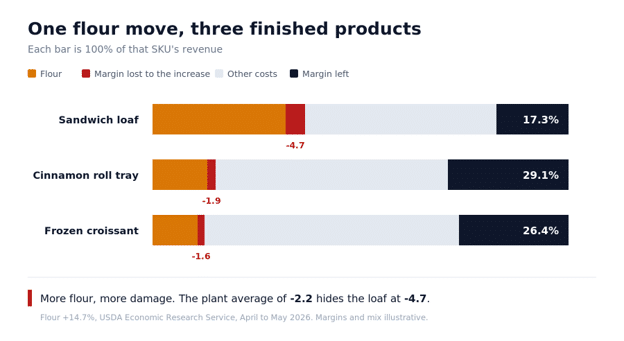
Most bakeries still capture yield on a clipboard and key it in later, so the variance is real long before anyone sees it. Pulling measurements straight off the plant floor is usually the missing link.
The quieter one is substitution. When a shortening supplier comes up short, production swaps in an approved alternate at a different price. The batch runs, ships, and invoices correctly while the cost record still reflects the original ingredient.
So, the swap becomes traceable only when it writes a cost rather than an inventory movement, which is why connected quality management belongs on the controller’s list and not only on QA’s.
What a Late Variance Costs
The standard sequence runs as follows: produce, ship, invoice, close, and discover. By the time the variance report lands, price protection windows have closed, promotional calendars are locked, and contract renewals are signed.
A controller then spends the close explaining a number instead of preventing it, while the CFO forecasts the next quarter from data describing a quarter already spent.
The balance sheet exposure is harder to argue with because standard costing is governed by an accounting rule and not by management preference. ASC 330-30-12 accepts standard costs only when they’re adjusted at reasonable intervals to reflect current conditions, so that at the balance sheet date they reasonably approximate cost computed on a recognized basis such as FIFO or average cost.
Read that against a wheat market that moved 14.7% in a month. Once variances grow large enough, the share still sitting in inventory must be capitalized back onto the balance sheet rather than left in cost of sales, which makes a stale standard more than a margin problem.
At that level, the widening gap becomes an inventory valuation the auditors will want explained and for a manufacturer borrowing against inventory, a number the lender reads too.
Staffing fixes neither problem because this is what happens when an ERP system for food manufacturers is built for general ledger accuracy rather than formula-level costing, with manufacturing bolted on afterward instead of built in from the start.
How Acumatica Process Manufacturing Prices Every Batch
Everything above describes the same problem: the cost data exists somewhere but does not connect on its own. Acumatica Process Manufacturing, built on the Quality Management Suite (QMS), holds cost as a structural part of the formula rather than a field updated each quarter.
Formula-Level Cost Rollups Built Into the Recipe
Acumatica Process Manufacturing rolls up both existing and theoretical costs to formulas, intermediates, and finished goods, so changing the cost of flour shows the effect on every SKU that uses it, including nested formulas where one intermediate feeds a dozen finished items.
Because the rollup carries theoretical costs alongside actual ones, a finance team can price a formula before committing to it. This approach changes the question from what margin was last month to what it will be on the next price sheet. It also turns a more frequent cost roll into a routine exercise rather than a quarterly project.
Actual Batch Costing Captured at Production
Real-time rollups handle the forward view, while actual batch costing handles the reconciliation. Batch-level capture records what the line consumed, what it yielded, and what was substituted against the standard for that same batch.
That separates purchase price variance from yield and substitution variance while the batch is still identifiable, rather than at close when all three have collapsed into one number. Co-products and by-products are also calculated correctly rather than absorbed into a plant-level figure.
From Month-End Discovery to Same-Week Correction
Standard versus actual stops being a month-end discovery and becomes a running comparison, so the close turns into clear confirmation. That’s the key argument for a purpose-built manufacturing platform over general ledger tools carrying a production bolt-on. The costing features are worth seeing before you evaluate vendors and make the final decision.
Making the Switch to Real-Time Bakery Costing
Quarterly standards, clipboard yield logs, and substitutions that never write a cost cannot track markets that move month to month because none of them were built to reprice a formula between one close and the next.
Working harder at close doesn’t solve that. What does, however, is costing that follows the market, variances separated while someone can still act on them, and margin visible by SKU rather than by plant, all running on the same clock the market does. That is just one piece of a wider modernization path for food manufacturers.
Contact SWK here to learn more about Acumatica’s formula-level costing and how we can help ensure your ERP provides the margin visibility your close depends on.