
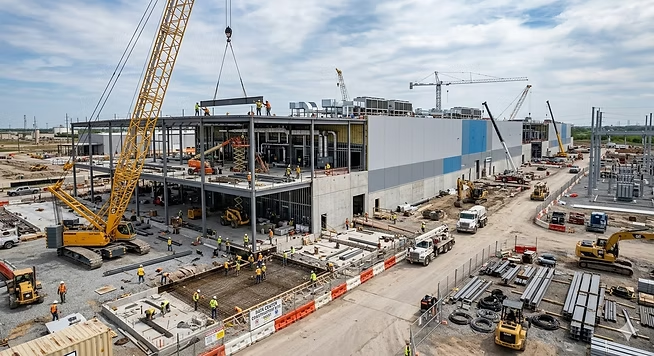
For general contractors managing data center projects, power delays are no longer just scheduling issues. They are forecasting problems that many legacy financial controls were not built to handle. Colliers’ 2025 Data Center Marketplace report points to grid limitations, supply chain constraints, and community resistance as major obstacles delaying — and in some cases canceling — data center projects. When a utility interconnection date moves, timelines often shift with it. Cash timing, work-in-process (WIP) assumptions, revenue projections, and margin forecasts may all need to be adjusted.
Owners and hyperscaler clients increasingly expect real-time cost and schedule transparency before awarding the next phase. A contractor that cannot show how grid delays affect cash exposure, committed costs, and margin forecasts may be at a disadvantage before the next pursuit begins. Fortis Construction makes a similar point: data center clients want greater schedule and cost certainty, but not at the expense of quality.
The Grid Is No Longer a Predictable Planning Tool
EY-Parthenon has reported that projects requiring new power supply and transmission infrastructure can stretch to five to eight years, compared with one to three years before the pandemic. Berkeley Lab’s Queued Up 2024 report also found that nearly 2,600 GW of generation and storage capacity was seeking grid interconnection, more than twice the installed capacity of the U.S. power plant fleet. While many queued projects will never be built, the backlog shows how crowded grid planning has become.
Market analysis from MSI/MOCA identifies 2025–2026 as a critical inflection point for U.S. data center capacity additions. Contractors are managing that uncertainty now, while active and planned builds continue moving forward at scale.
The COO Problem: Portfolio Controls vs. Site Execution
The data center surge is creating more concurrent projects, entities, and shared exposure to the same grid delays. Most operational control structures were built for less complexity.
When a firm runs eight or ten programs at once and several face utility delays, schedule certainty stops being only a site execution issue. Field management cannot resolve a delay that starts in a utility queue. Project teams are natural problem-solvers, so they may try to recover lost time in the field before the financial impact is fully escalated. Operations leadership needs to see the financial impact as schedules move across the portfolio, not after a milestone has already been missed.
The CFO Problem: Cash Forecasts and “Phantom Margins”
Large data center power requests—often ranging from hundreds of megawatts to 1 GW or more—can now carry lead times of one to three years before interconnection is secured. A cash forecast built on a milestone that could move by 12 months or more is less a forecast than an assumption. A GC may carry major commitments for long-lead equipment, site work, subcontractors, and staffing before key billing milestones. Many exposures begin during pre-contract procurement—before the project structure is active in the accounting system.
If the power timeline slips, cash may go out before revenue comes in. Without scenario planning tied to power milestones, financial statements can overstate project health, hiding liabilities behind a temporary “phantom margin” until cash strain emerges. The issue is whether the CFO can see the exposure early enough to adjust forecasts, protect working capital, and communicate clearly with stakeholders.
The CEO Problem: Portfolio Margin Is Visible Too Late
When project status lives in isolated spreadsheets and month-end files, portfolio visibility remains retrospective. By the time a cash surprise or bonding constraint surfaces, leadership is already behind the problem.
A delayed interconnection date may be explained by one project team, but executive leadership needs visibility into committed costs at the moment purchase orders are issued—not weeks later when invoices arrive. The CEO problem is not simply that one project is delayed. It is that there may be no real-time view of portfolio margin across delayed, exposed, or reforecasted programs.
Leadership needs to know which programs carry the highest grid exposure, which margin assumptions rely on shifted baselines, and which programs could pressure bonding, credit, or working capital. Relying on a standard monthly close leaves leadership managing from old information. It also increases pressure around accurate month-end construction accruals when schedule changes are not reflected quickly enough.
Regulatory Fixes Will Not Clear the Near-Term Queue
PJM’s cluster-study reforms and the U.S. Department of Energy’s “AI for Interconnection” initiative are meaningful steps forward. PJM has reported progress in clearing transition-cycle interconnection studies, while DOE announced up to $30 million to accelerate interconnection through artificial intelligence techniques. But these efforts will not remove the uncertainty facing data center programs already moving through preconstruction and active execution.
The strategic question is not simply when the grid gets fixed, it is whether financial controls can absorb the uncertainty until it does. Near-term projections still depend on how quickly accounting and finance teams can model moving milestones, cash exposure, and changing margin assumptions.
How Sage Intacct Planning Helps Finance Reforecast
Sage Intacct Planning helps accounting and finance teams move from static forecasts to scenario-based forecasting connected to live actuals and dimensions. For data center contractors, that matters because a six-month power delay can change cash timing, revenue assumptions, cost-to-complete expectations, labor plans, equipment schedules, and working capital needs at the same time.
Scenario-based forecasting through Sage Intacct Planning gives finance teams a way to model those effects without rebuilding forecasts from scratch. Dimensions also help finance evaluate exposure by project, customer, entity, program, or milestone.
Construction consulting firm Aegis Project Controls reported a 5x improvement in overall accounting efficiency after moving to Sage Intacct. The company also increased budget vs. actual reporting from quarterly to monthly, reducing a process that previously took four or five days per quarter to about 30 minutes each month.
See Where Your Forecasting Process May Be Exposed
Early procurement, unrecorded commitments, and unpredictable grid timelines are now permanent fixtures of modern data center development. The true risk is not the moving milestone; it is the financial blind spot it creates.
SWK Technologies helps construction firms assess whether their financial systems can withstand the scale and speed of modern data center programs. Connect with SWK Technologies today to evaluate your forecasting workflows, protect project margins, and keep financial controls aligned with field operations.