

CYBERSECURITY SOLUTIONS
Compliance
Cybersecurity Compliance Services
SWK Technologies offers cybersecurity compliance assessment and enablement services to help you ensure your business can face both an audit and modern cyber threats. A checklist is not enough to prove you are meeting current data security regulations, or even cyber insurance requirements as the burden of proof becomes more demanding in the wake of worsening cyber attacks. Firewalls, MFA (multi-factor authentication) and a written policy are good starting points, but these alone will not suffice to demonstrate you are effectively protecting your customers’ information to auditors.
Many cybersecurity regulations require documented third-party risk assessments to validate and certify the effectiveness of security controls in place. An independent validator such as SWK provides an objective source of truth for regulators that your defenses meet the minimum obligations, and that your business maintains records of your protection efforts and improves upon them regularly. An external partner also serves as a potential resource for additional training and other compliance enablement services as you need them.
What Cybersecurity Regulations Require

Regulatory examinations generally focus on whether a security program addresses realistic threats and whether a business can produce documented proof of that. Many industry-specific cybersecurity compliance frameworks explicitly require independent security assessments in sectors a breach could affect large numbers of people — defense contractors, financial institutions and healthcare organizations among them. For others, external validation by a certified third party is the most defensible way to establish that compliance is genuine, not assumed.
Across different industries, auditors look at several consistent areas, including:
- Cyber risk evaluation – Regulators expect businesses to identify what data they hold, assess the likelihood and impact of threats to that data, and keep those evaluations current. Outdated cyber risk assessments are treated as evidence of a program that has lapsed, not one that is operating.
- Security control validation – Auditors distinguish between controls that exist and controls that work. Documentation must show not only that security tools and configurations are in place, but that they have been tested and verified against real attack scenarios.
- Incident response planning – Examiners expect documented plans that specify who handles what in the event of a breach, how affected parties are notified, and how the business recovers. Post-incident reviews identifying root causes and corrective actions are part of the expected record.
- Business continuity and disaster recovery – Backup and recovery procedures must be tested, not just written. Regulators look for documented recovery time and recovery point objectives that have been verified against actual results.
Cybersecurity Compliance Frameworks SWK Supports
Different industries operate under distinct IT security compliance requirements. SWK Technologies performs assessments aligned with several cybersecurity regulatory frameworks, including:
NIST Cybersecurity Framework
The National Institute of Standards and Technology (NIST) Cybersecurity Framework (CSF) is the foundational reference for SWK Technologies’ full-service cyber defense program, CyberAssurance COREtm, which includes SWK’s risk assessment services. Widely adopted across sectors as a baseline for multiple data privacy regulations, the NIST CSF 2.0 organizes security activities across six primary functions: Identify, Protect, Detect, Respond, Recover and Govern. Many sector-specific regulations either reference or align with these principles
HIPAA
Healthcare organizations handling protected health information (PHI) are subject to the HIPAA Security Rule, which requires periodic risk assessments to identify threats to electronically stored data. Covered entities must document those assessments and demonstrate how identified vulnerabilities have been addressed. Cyber insurance carriers for medical facilities increasingly specify independent security assessments as a policy condition, with some requiring controls such as endpoint detection and response and security operations center monitoring before coverage is issued.
CCPA
The California Consumer Privacy Act (CCPA) and its amendment, the California Privacy Rights Act (CPRA), impose data security obligations on businesses that collect personal information from California residents. While neither law mandates specific security controls, both require businesses to implement reasonable security measures appropriate to the nature of the data they handle — and businesses that suffer a breach of unencrypted personal data may face statutory damages and regulatory scrutiny over whether those measures were adequate.
CMMC
Defense contractors handling Controlled Unclassified Information must demonstrate compliance with the Cybersecurity Maturity Model Certification (CMMC) at the level applicable to their contract scope. CMMC assessments evaluate whether required security practices have been implemented across relevant systems, with certification for Level 2 and above requiring formal third-party assessment.
PCI DSS
Businesses processing credit card transactions are subject to Payment Card Industry (PCI) Data Security Standard (DSS) requirements, including periodic vulnerability scans and annual penetration tests conducted by approved vendors. Documentation of remediation for high-risk findings is required for businesses continuing to process transactions, and failure to maintain compliance can jeopardize this.
23 NYCRR 500
New York’s cybersecurity regulation for financial services businesses, 23 NYCRR 500, requires covered entities to maintain a cybersecurity program based on a documented risk assessment and to perform periodic penetration testing and vulnerability assessments on a defined schedule. The regulation specifies that penetration testing and vulnerability scans be conducted annually to bianuually, respectively.
Cybersecurity Compliance Assessment Services
SWK Technologies provides independent cybersecurity compliance assessments that help businesses identify vulnerabilities, validate controls and produce the documentation that regulators and auditors look for. These services are available individually or in combination depending on the scope of your industry-specific compliance obligations:
Vulnerability Assessment
A vulnerability assessment systematically evaluates a network environment to identify known security weaknesses and determine their severity. SWK scans both external-facing assets — public IP addresses, web services, cloud resources — and internal network environments to surface misconfigurations, authentication gaps and unpatched systems that may expose sensitive data. Findings are prioritized by risk level and accompanied by recommendations for remediation.
Unlike a penetration test, a vulnerability scan does not attempt to exploit identified weaknesses. It provides a surface-level picture of what is present and directly visible, making it the appropriate starting point for businesses establishing a compliance baseline or preparing for an audit.
Penetration Testing
A penetration test goes beyond scanning to actively attempt exploitation of identified vulnerabilities, validating whether perimeter and internal controls can withstand an actual attack. SWK’s testing methodology follows a structured sequence: gathering information about the target environment, identifying and validating vulnerabilities through automated and manual techniques, and then cautiously attempting exploitation to determine the actual impact a malicious actor could achieve.
Where a vulnerability assessment shows what gaps exist, a pen test demonstrates what those gaps make possible. For businesses subject to regulations that require documented proof of control effectiveness — not just control existence — pen testing is the standard the evidence needs to meet.
Cyber Risk Assessment
SWK’s cyber risk and threat assessment evaluates how well your existing security policies, procedures and controls align to the requirements of applicable frameworks. Using a methodology grounded in NIST CSF principles, this review combines automated network scanning with structured questionnaires to identify gaps between current practice and compliance expectations.
Findings are documented in formats suitable for regulatory submission, board presentation and audit response. SWK performs readiness assessments for HIPAA, PCI DSS, CMMC and GDPR, in addition to NIST-aligned reviews.
Learn More About Compliance with Different Regulations
Stay up-to-date with the latest regulatory changes and guidance:

HIPAA IT Compliance Guidance for Multi-Site Rehab Facilities
Running a rehabilitation or any other healthcare practice across several locations means the same patient records move between sites every working day, whether physically or digitally. Each additional …
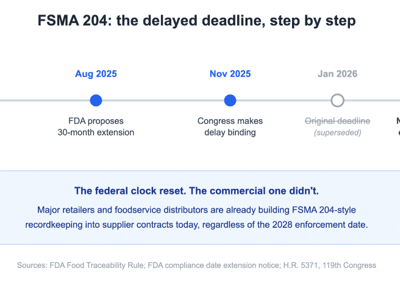
Why Your Bakery ERP’s Lot Trace Takes Three Days (And Costs More)
Midmarket commercial bakery and food process manufacturers rely heavily on spreadsheets, paper logs, and disconnected systems, so that a complete lot trace ends up taking three days. At the same time, …
What the SEC Regulation S-P June 2026 Deadline Means for Financial Advisors
The June 3, 2026 deadline marks the second and final compliance phase for the amended U.S. Securities and Exchange Commission (SEC) Regulation S-P, the federal privacy rule governing how …