
Midmarket commercial bakery and food process manufacturers rely heavily on spreadsheets, paper logs, and disconnected systems, so that a complete lot trace ends up taking three days.
At the same time, legacy ERP software, which many food and beverage manufacturers still use to automate processing and distribution operations, was never built to handle a traceability request in a day, as FSMA 204 requires. Such systems still treat a lot number as a static field instead of a queryable chain.
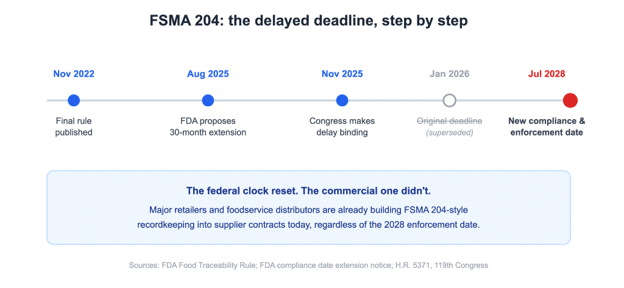
The new standard, which is slated to go into effect by July 2028 at the time of this writing, requires linking Critical Tracking Events (CTEs) across the supply chain. Quality and Food Safety Managers feel that pressure every time a documentation request lands on their desk. For CFOs and Controllers, the cost shows up later as wider recall scopes and audit findings that could have been avoided.
The Case for Bakery ERP Software Modernization
The federal clock reset, but the commercial one didn’t. Understanding what the rule actually asks for and why spreadsheets and legacy systems can’t produce it is where ERP modernization starts.
Understanding FSMA 204 Lot Traceability Requirements
The rule requires commercial bakery and related food process manufacturers to capture and link Key Data Elements (KDEs) at each CTE, for foods on the Food Traceability List (FTL). Records must connect on demand so that a finished lot traces backward through every ingredient lot and forward through every case shipped, within 24 hours.
The FTL list includes a narrower set of high-risk items than many assume, such as fresh produce, shell eggs, nut butters, soft cheeses, several seafood categories, and ready-to-eat deli salads. Few finished baked goods land on the FTL directly, but plenty of bakery and snack operations still handle a listed ingredient in the unprocessed form the rule covers.
Most large retailers and foodservice distributors now expect FSMA 204-style recordkeeping from every supplier, regardless of whether the FTL technically applies to their finished product. Coverage often comes down to the “kill step”, explains Blake Harris, technical director of IFT’s Global Food Traceability Center. Whether a listed ingredient undergoes a baking or cooking process that changes its form or is added afterward and stays as it was.
FDA’s March–April 2026 readiness exercises found that most firms could meet the 24-hour deadline, yet only 40% captured a properly assigned lot code at every tracking event and 27% captured the traceability lot code (TLC) source at every CTE. That’s a fundamentally different bar than most bakery ERP software was built to clear, since legacy ERP systems log a lot number as a static field and call it ‘traceability’.
Spreadsheets and Siloed Systems Cannot Meet This Standard
Most manufacturers didn’t choose spreadsheet-based traceability as a strategy, but rather they grew into it by default. A formula changes, a co-packer gets added, a new SKU launches for a private label program and the tracking method that worked for ten lots a week stops working at fifty.
The failure points repeat across plants, regardless of sub-vertical. A warehouse management system captures receiving lots, yet not what went into a given batch on the floor. Meanwhile, a production team logs batches on paper because the ERP screen is too slow or disconnected for real-time entry.
Supplier documentation often adds another failure point. When a certificate of analysis arrives after the lot is already on the floor or lists a number that doesn’t match what receiving logged, reconciling that mismatch becomes the Quality Manager’s job.
Earl Arnold, AIB International’s global manager for food defense and FSMA, highlighted these gaps mismatched systems create at IBIE 2025: “What a supplier is recording may in no way correlate to how a baker is recording. Those different documentation systems make traceability difficult because databases don’t talk to each other.“
That’s how a 24-hour regulatory request turns into a multi-day reconciliation project. And no, the people involved are not to blame. It’s just what happens when an ERP system for food manufacturers is built for general ledger accuracy, not lot-level genealogy, with traceability bolted on afterward instead of built in from the start.
The Compounding Costs of a Slow Lot Trace
Major retailers and food service distributors have already started building FSMA 204 recordkeeping into supplier contracts and sourcing standards, sometimes on timelines earlier than the federal deadline. Therefore, a bakery or snack manufacturer that can’t produce a clean trace during a customer audit already risks delisting today.
Once federal enforcement begins, a documented gap in CTE records can trigger a warning letter on its own, independent of whether contamination is ever confirmed. That pressure isn’t uniform across channels as club and private label programs carry the shortest audit-to-cure windows, while grocery and foodservice relationships allow more back-and-forth before a delisting decision.
A manufacturer selling across all of these channels from one plant is really managing to its strictest customer’s timeline, whether the system is built for that or not. For CFOs and Controllers, the financial exposure compounds from there.
When genealogy is incomplete, recall scope defaults to the widest defensible boundary, which represents every lot that might be affected, as no one can prove otherwise. In the end, a recall that should have touched three days of production ends up touching three weeks.
How Acumatica Process Manufacturing Automates Compliance
Everything above describes the same problem: the lot data exists somewhere in the business but doesn’t connect on its own. Acumatica Process Manufacturing, built on the Quality Management Suite (QMS), has every recorded lot number living inside the ERP as a structural part of every transaction.
CTE-Level Lot Capture Built Into the Transaction
Every Critical Tracking Event the rule requires, from receiving to transformation, creation, and shipping, gets captured natively as material moves through the plant. A raw material lot, with its supplier documentation, carries its identity forward through every batch it’s consumed into and a finished lot carries that full history forward through every case it ships in.
As Acumatica Process Manufacturing is built with integrated formula-based production, the genealogy holds even when a batch is scaled, split across lines, or reworked, marking exactly the points where spreadsheet tracking breaks.
Mobile devices let floor staff and quality technicians trace forward or backward from any point in the chain, without waiting on a spreadsheet export or a call to the warehouse. Acumatica’s 2026 R1 release added a Shop Floor Kiosk for logging lot and serial numbers at the work center, as well as automatic lot and serial number generation during receiving, so the genealogy chain builds itself as a byproduct of normal floor activity, not a separate compliance task.
Supplier Documentation Linked at Receiving
Earlier, a certificate of analysis arriving after the lot was already on the floor, or listing a number that didn’t match what receiving logged, was one of the most common failure points.
Acumatica closes that gap by attaching supplier documentation to the raw material lot at the point of receiving, not as a separate file to reconcile later. That lot identity, documentation included, carries forward automatically through every batch it’s consumed into, so a mismatched certificate of analysis surfaces before it becomes the Quality Manager’s problem, not after.
From Manual Lookup to Mock-Recall-Ready
Built-in non-conformance reporting, CAPA and quality compliance controls, and a complete audit trail mean a mock recall is a simple query. As such, a Quality or Food Safety Manager can pull a full genealogy report, upstream and downstream, in the time it used to take to open the first spreadsheet.
The shift from a multi-day reconstruction to a same-day response is the same readiness that a retailer’s compliance team checks for during a customer audit, well before any recall ever happens.
Taking the First Step to Bakery ERP modernization
Manual lot tracking across spreadsheets, paper logs, and disconnected systems cannot meet these new requirements, as none of those tools were built to link a lot number across receiving, production, and shipment in real time. Acumatica closes that gap, delivering 24-hour requests answered the same day, customer audits grounded in real-time records, and any recall confined to the lots actually affected.
Contact SWK here to learn more about Acumatica’s ability to capture CTE-level traceability and how we will help you ensure your ERP provides the visibility you need for modern compliance